

That unnerving feeling surreptitiously sneaks up on you like that next episode on Netflix you promised you wouldn’t watch.
The itching for something sweet, the tingling for something salty, and the impulse to suddenly throw your hard-earned efforts out the window by devouring all the food you can see in one sitting.
The problem is it’s not time for a main meal, that small snack doesn’t really leave you satisfied, and, oh damn, it’s only 9.30 in the morning.
Cravings have the ability to turn a well-intentioned day into a full-blown war and derail your best ambitions with the click of a finger.
The bubbling feeling that leaves you stuck between seeking control and desperately wanting immediate relief.
Which naturally raises a few important questions:
If something this intense can hijack our thoughts, emotions, and behaviours so rapidly, what’s really happening beneath the surface?
What are cravings? Why do they surface?
And, most importantly, how can we deal with them without feeling like we’re never going to eat a chocolate-glazed doughnut ever again?
What Are Cravings?
Cravings have been defined as strong, persistent urges for specific, usually high-calorie foods [1].
They often act as a form of comfort or emotional coping and, most importantly, aren’t often an indicator of true hunger. They’re short-lived but powerful brain states that make certain foods feel unusually important, urgent, and hard to ignore.
It’s why cravings can also be defined as experiences, not just fleeting impulses. They tend to encapsulate:
-> Thoughts (‘I need the chocolate bar now’)
-> Images (Picturing food)
-> Sensations (Salivating and tension)
-> Emotion (Anticipation and then relief)
Cravings are primarily a distinct motivational state that pushes behaviour.
It also makes sense to blame cravings on ‘willpower’ or a ‘lack of motivation,’ right?
Unfortunately, it’s not that simple.
Cravings ostensibly surface from a complex assemblage of brain chemistry, hormones, learned behaviours, and food availability.
Further, those ‘hyperpalatable’ foods (a delicious concoction of sugar, salt, and fat) activate the brain’s pleasure centres and disrupt hunger and fullness signals, making us want more even when we’ve eaten enough.
Over time, this can create habitual cravings, especially for comfort foods that reduce stress.
Ultimately, cravings shouldn’t be defined as your fault, but a predictable and understandable response shaped by biology, psychology, and your environment.
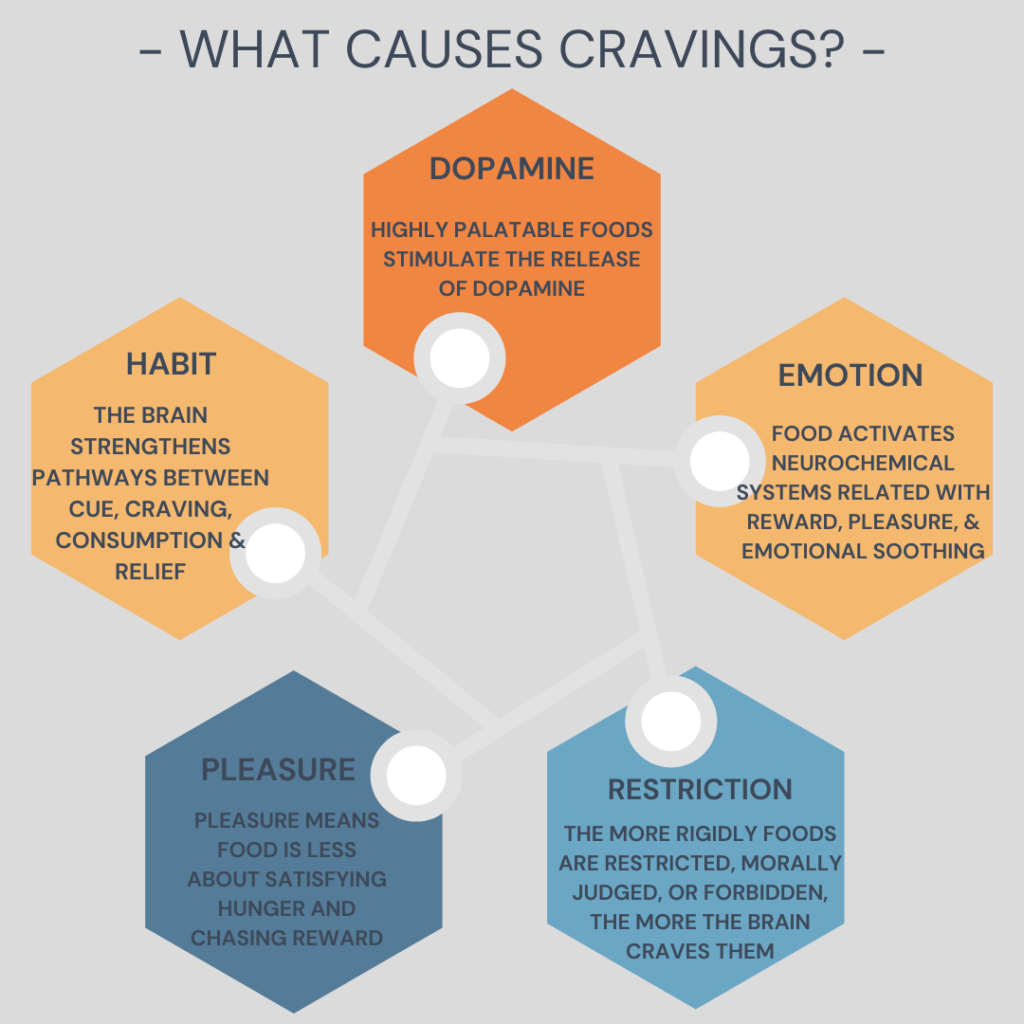
What Causes Cravings?
‘It Tastes So Good!’
The consumption of highly palatable foods strongly stimulates the release of the ‘feel good’ neurotransmitter, dopamine.
Gradually, the brain learns to assign high motivational value to these foods, making them feel particularly tempting.
That chocolate cookie you keep consuming becomes more important, more desirable, and worth pursuing.
Additionally, the release of dopamine exacerbates the feeling of anticipation.
This means that the environmental cues surrounding food (the time of day, your emotional state, smells, etc.) all trigger a small dopamine release before you’ve even started devouring the chocolate cookie.
This creates an ‘anticipatory drive’ and explains why cravings surface suddenly, feel intrusive, are triggered by external cues, and often persist even when we’re full.
Ultimately, the brain temporarily assigns excessive significance to specific foods, driven by learned reward prediction rather than true physiological ‘need’.
‘I’m Feeling…’
When we experience any particular emotion, our brain will naturally seek the fastest, most reliable source of emotional relief.
And what does this best? Food.
The crisps, sweets, and sugary drinks rapidly activate neurochemical systems associated with reward, pleasure, and emotional soothing, making them an efficient short-term coping strategy.
It’s why you always seek out the snack cupboard when you’re feeling stressed, angry, or upset.
Subsequently, eating becomes negatively reinforcing and dampens or eschews unpleasant feelings. This relief strengthens the association between emotional distress and eating, even when you’re not actually hungry.
Because people can’t tolerate or sit with uncomfortable emotions, food-seeking behaviour is often triggered subconsciously.
It’s no wonder, therefore, that cravings are exacerbated during stretches of emotional discomfort, are more prominent when emotional regulation is limited, and are often heightened during periods of fatigue, overwhelm, and burnout.
‘I Can’t Have This!’
It’s been found time and time again that severe dietary restriction increases cravings [2].
When foods are labelled as ‘off-limits,’ ‘bad,’ or ‘forbidden,’ they become psychologically restricted, paradoxically increasing their motivational power and making them more emotionally loaded and desirable.
Not only does limited access to something increase its value, but the more you restrict, the more likely you are to think about that very same item.
It’s why cutting out ‘chocolate or (worse) ‘sugar’ seldom lasts longer than a few weeks.
People become stuck in a ‘restrict-overindulge’ cycle in which increasing perceived control (‘I can’t have this’) fuels preoccupation, leading to eventual loss-of-control episodes, guilt, and further restriction.
The more rigidly foods are restricted, morally judged, or cognitively forbidden, the more powerfully the brain craves them.
‘Food Brings Me Pleasure And Joy’
Every time you eat something, it brings you pleasure.
This is known as hedonic eating: the pull toward the sensory pleasures of food — the smoothness of ice cream, the rich sweetness of chocolate, and everything in between.
It’s no wonder that pleasure and joy keep us coming back for more.
Importantly, hedonic pleasure also reduces sensitivity to natural hunger and fullness cues.
When pleasure becomes the dominant driver, eating becomes less about satisfying hunger and more about chasing reward, thereby increasing the frequency and intensity of cravings.
Add to that the abundance and convenience of most hyperpalatable foods and it’s easy to see how eating can easily become habitual and dysregulated, reinforcing a cycle of anticipation, craving, consumption, and short-lived satisfaction.
Acknowledging that cravings are often driven by pleasure rather than nutritional need allows for a more compassionate perspective on our eating behaviours.
‘Habit!’
The brain forms links between specific foods and specific outcomes, such as comfort, stress relief, and reward.
Every time you eat something, the brain will strengthen the neural pathways connecting the cue (seeing the snack cupboard), the craving (‘I want a biscuit!’), the consumption (‘This cookie tastes great’), and the final relief (‘That feels so much better’).
Over time, this creates automatic habit loops that run in the background of conscious awareness. When that cue surfaces, the cycle then kicks in.
Subsequently, rather than consciously deciding to want a particular food, individuals experience cravings as sudden mental events that simply appear.
It’s why some cravings are memory-based responses rather than true wants or desires.
To Combat Cravings, You Must Do This First
When that craving surfaces, eating is often all we can think about. It’s all we truly want.
Why would we want to ask if we’re hungry, identify an emotion, work on breathing practices, or potentially do something that will get in the way of this much-desired release?
If we believe that ‘craving success’ is only defined by not eating or drinking, we will resist engaging in any processes to manage the situation. We’ll prevent ourselves from making any efforts to do the appropriate work – especially if we view eating that particular food item as ‘bad’ or ‘forbidden’.
We then either don’t engage in these emotional eating strategies at all or avoid putting in maximum effort, therefore, reducing the chance of succeeding at anything.
The answer?
Give yourself permission to still eat once you’ve worked through the necessary craving strategies.
-> ‘I desperately want the cake. I’m going to have it if I still desire it after working through my craving practices.’
-> ‘It’s OK to have a glass of wine. This does not make me a bad person. I’m going to still do the work first, though.’
-> ‘I’m allowed this biscuit, but I’ll do the work first.’
Without that initial resistance, you can put your full focus on getting curious, identifying those emotions, checking in with yourself, and still deciding to eat something if it’s the right release at that moment.
Just as suppressing emotions seldom works, suppressing the desire for a particular food or drink item rarely helps either.
7 Ways To Beat Your Cravings Forever
1. Start Recognising True, Physical Hunger
Many dieters have spent so long adhering to rigid dieting rules that they can’t distinguish between whether they’re truly hungry or simply bored and/or feeling emotional.
They’ve always eaten when they’re not hungry and forbid themselves from eating when they are. They possess little regulation over when to eat and when not to.
Instead, it’s time to practice the skill of recognising when you’re truly hungry.
When you can recognise when you’re actually hungry, it doesn’t matter what or when you eat. You’ll know what foods to consume, how much to eat, and don’t have to ‘wait’ until a rule tells you to do so.
You may decide that having the snack at 3 pm is perfectly acceptable because you’re hungry. You may conclude, however, that you need to do something else to appease that craving because food isn’t what you need in that moment.
By reconnecting with your instinctive signals, you can manage your consumption without restrictive dieting or obsessing over every bite you take.
When you can recognise true hunger, you’re less likely to feel guilt around eating and stop eating just for the sake of it.
You’re more likely to choose foods that will nourish you and will feel more satisfied with your overall choices.
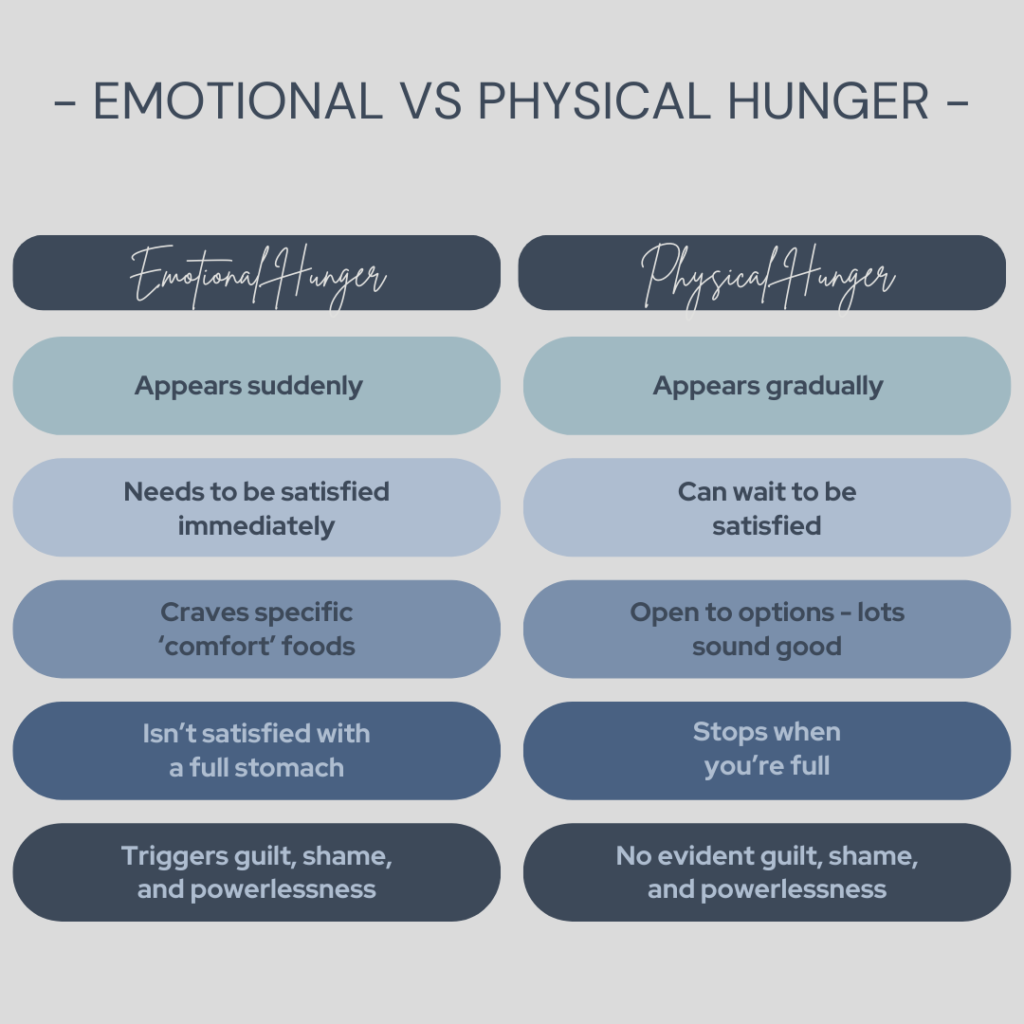
Whenever you feel the temptation to eat, start working through the definitions and hunger questions mentioned above. Distinguish whether it’s physical or emotional hunger you’re experiencing.
When it’s typically time for a ‘main meal’ (i.e., breakfast, lunch, dinner, etc.) you may well realise you’re physically hungry.
Should it be mid-afternoon or post-dinner, however, you may ascertain you’re experiencing emotional hunger.
Starting to recognise which is which – and what patterns emerge throughout your day – will help you understand at what times and situations you’re more likely to experience each.
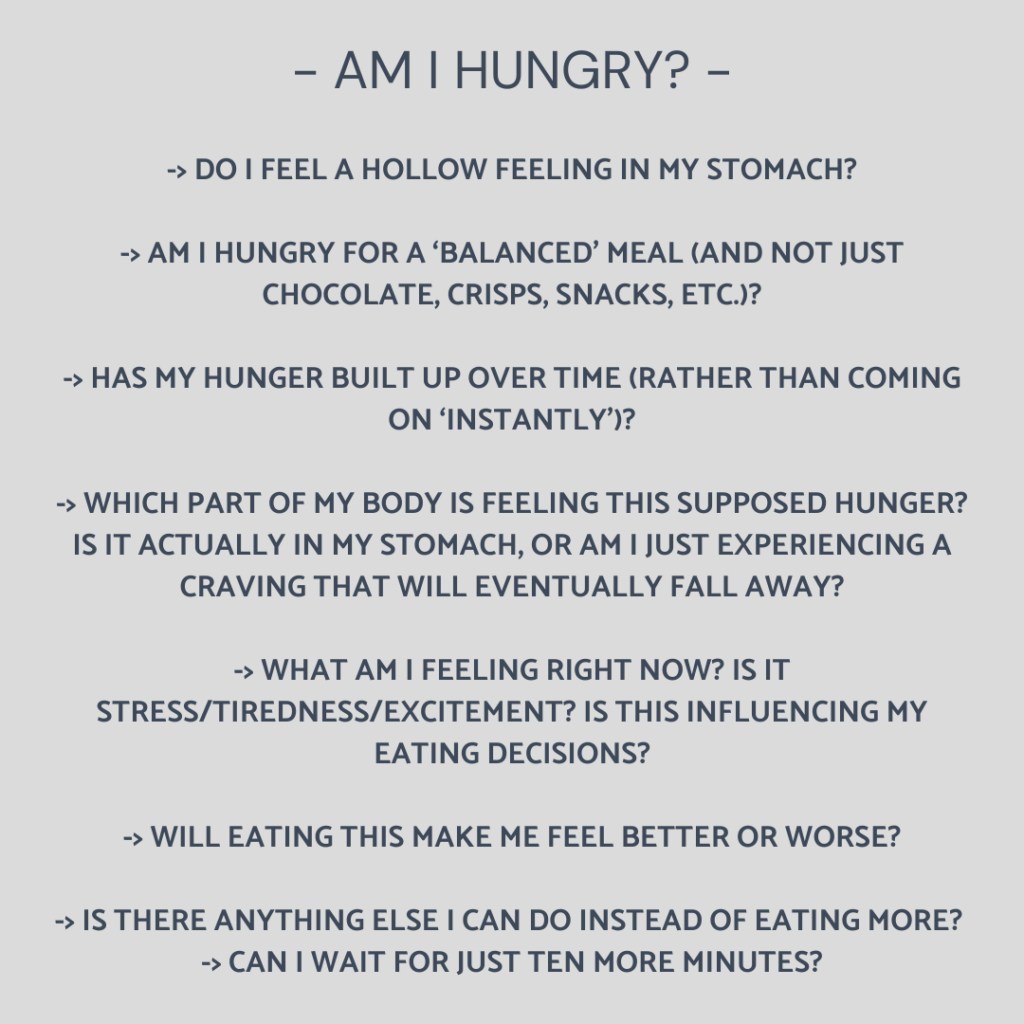
It is also good practice for ‘pausing, thinking, and then acting’. This is crucial in avoiding acting on impulse and slowing down your decision-making.
Of course, there are no right or wrong answers here. Only you know what you’re experiencing.
The important thing isn’t to necessarily try to act on this straight away. You may well figure out that you’re experiencing emotional hunger and still eat. That’s OK!
2. Sit With The Discomfort Of ‘Wanting More’
When that craving surfaces, that wanting is an alluring force.
It can be incredibly hard to overcome.
Sometimes, however, we need to practice sitting with that discomfort of ‘wanting more’ – and be prepared to not act on those feelings.
Just as we need to sit with uncomfortable emotions at times, we also need to sit with not acting on desires all the time.
This, in itself, is also a skill to practice. We’re naturally wired to seek comfort and avoid discomfort, and just as we often struggle to sit with difficult emotions like anxiety, frustration, or sadness, we also struggle to sit with unfulfilled desire.
Yet learning to tolerate this temporary discomfort is a crucial part of building emotional and behavioural flexibility.
Every time we resist the impulse to immediately satisfy a craving, we weaken the automatic link between ‘urge’ and ‘action’.
Over time, this teaches the brain that discomfort doesn’t require instant relief, and that urges can rise, peak, and fall without being obeyed. This reduces both the intensity and frequency of future cravings.
The next time you feel yourself wanting something – whether that be a snack, a second serving of dinner, or to purchase something from a shop as you pass – just practice pausing and sitting with that feeling of desire.
Get curious with how your body feels, how long that ‘itch’ lasts, and what actually happens should you not act immediately.
The more you practice, the better you’ll get.
3. Surf The Urge
Just like a surfer rides the waves in the ocean, we’re similarly able to surf the urges we experience. We’re not looking to speed up, slow down, carve the water, or repair our compulsions, but simply allow a craving to rise, crest, and fall.
We’re more accepting of a natural feeling and willing to withstand its power, without feeling the desire to fight, or act upon it.
This technique, labelled ‘surfing the urge’, is a valuable tool in practicing acceptance.
By acknowledging and observing the thoughts we have (for example, “I’m currently having the urge for a chocolate-covered Hobnob”) and being open to it, (“It’s perfectly acceptable to encounter this urge”), we’re able to let those impulses appear, then eventually fade away.
We know that suppressing any nagging thoughts only heightens their strength; by respecting them, we’re able to face their charm instead of fighting it.
Think about scoring the intensity of your craving on a scale of 1-10 (for example, “My desire for that Hobnob is now a raging 9”). Don’t feel the need to censor or reduce it; simply notice the thought and how it’s affecting your body.
You’ll soon see the craving start to dissipate (“My desire for that biscuit is now a 4”). Staying with your physical sensations – such as your breathing and the desire to reach for the biscuit tin – will allow the urge to rise, crest, and fall (“What biscuit?”).
Of course, if you’ve worked through those hunger questions we touched on before and figured out that you’re actually hungry, then surfing the urge isn’t needed.
It’s only possible when we decide that we’re experiencing that fleeting, emotional hunger.
Accepting the thought that we can’t control things gives us power back.
We’re no longer left trying to fight those urges – and subsequently failing – but are able to differentiate between what we do and don’t need to act upon.
4. The Opposite Action Technique
We know that cravings often follow a well-rehearsed habit loop, and, because these loops are automatic, cravings often feel extremely powerful.
The ‘Opposite Action’ technique works by breaking the loop at the ‘behaviour’ stage of a habit cycle and redirects the action [3].
The aim is not to explicitly eliminate the craving, but to prevent it from automatically dictating behaviour, eventually dampening that habitual link over time.
Whereas cravings may push us towards stillness, numbing, or isolation through food, Opposite Action aims to reverse this impulse through movement, connection, or a change in environment.
For example:
-> Standing and walking instead of sitting and snacking
-> Or connecting with a loved one and talking instead of withdrawing and eating
-> Or stretching and listening to music instead of doomscrolling and grazing
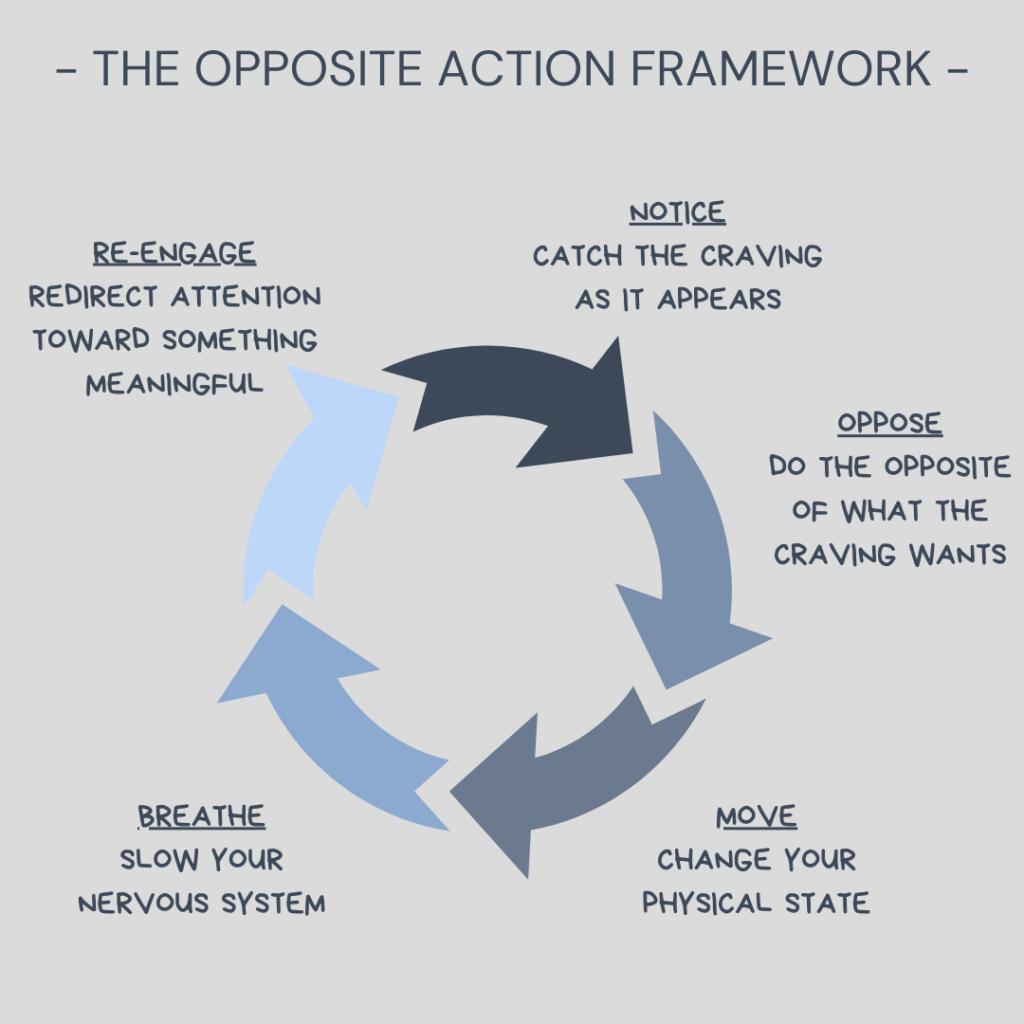
This purposeful shift creates behavioural friction, interrupting automatic habit loops and giving the craving space to rise, peak, and fall without being reinforced.
Over time, this weakens the urge–action link and restores a sense of choice.
When you next encounter a craving, think about changing what your body is doing.
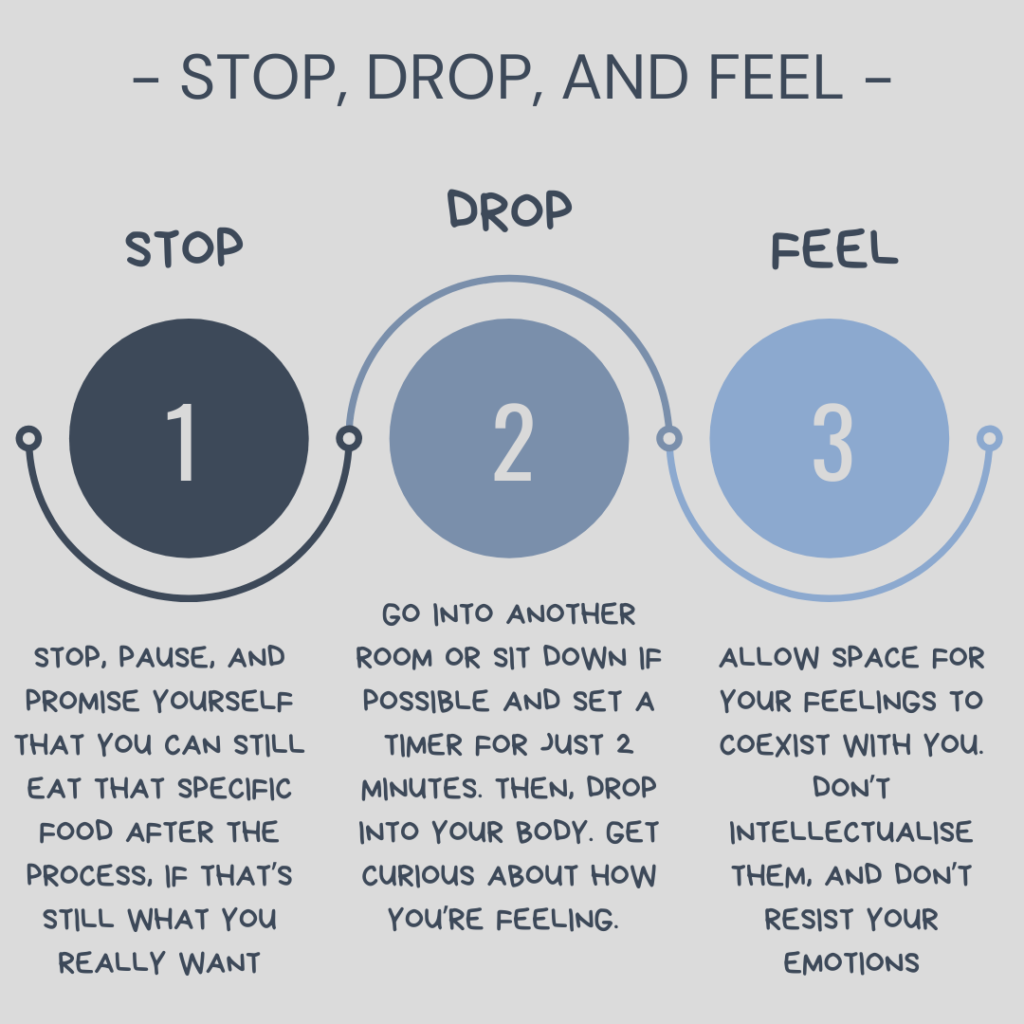
5. Stop, Drop, And Feel
Eating Psychology Coach Kari Dahlgren created the ‘Stop, Drop, and Feel’ method, a ‘tool for navigating out-of-control eating by developing emotional tolerance, the ability to withstand edginess without resorting to maladaptive coping mechanisms like turning to food for comfort’ [4]
Uncomfortable emotions not only cause cravings and drive us to overeat, but the urge can feel compulsive and out-of-control.
By enhancing emotional tolerance, however, compulsive eating patterns are likely to be significantly reduced.
Here’s how it works:
Stop: As soon as you’re feeling a craving because you’re angry/frustrated or about to reach for food when you aren’t necessarily hungry, stop, pause, and promise yourself that you can still eat that specific food after the process, if that’s still what you really want.
Give yourself permission first and then engage in those processes to figure out whether it’s what you need.
Drop: Then, go into another room or sit down if possible and set a timer for just 2 minutes.
Nothing more, nothing less.
Then, drop into your body. Get curious about how you’re feeling.
What emotions are you experiencing? What is the intensity of that emotion? What does your body physically feel right now? Can you lean into that discomfort? Is there anything else you can notice?
You may still have ‘I don’t care right now; I just want a snack’ thoughts – and that’s OK – but it’s important you still do this for two minutes, regardless.
Feel: Allow space for your feelings to coexist with you. Don’t intellectualise them, and don’t resist your emotions; that would only make the emotion grow stronger.
Instead, just spend those couple of minutes sitting still with your edgiest emotions.
Feel your feelings.
Even if you still have the urge to eat without hunger after working through this, the time spent won’t be in vain. Every attempt contributes to strengthening your emotional awareness, which will, ultimately, help you in the long run.
6. The Sensory Grounding Technique
It’s evident that most cravings aren’t owed to true hunger. Whether it be external stimulation, comfort, novelty, or simply regulation, cravings are often a sign we’re seeking something else.
The ‘Sensory Grounding’ technique shifts your attention away from those urges and impulses and directs them towards your body and immediate environment, bringing your nervous system back into balance.
By engaging all of our senses — sight, sound, touch, taste, and smell — we reduce cognitive fixation and emotional intensity.
Not only does this technique, again, act as a behavioural ‘speed bump’, but engaging other senses provides the stimulation and comfort the brain seeks.
Try the 5-4-3-2-1 technique when you feel an urge surface:
-> Identify 5 Things You Can See
Light, objects, animals, textures, etc.
-> 4 Things You Can Feel
A warm mug, cold water on your face, a weighted blanket, different textures, etc.
-> 3 Things You Can Hear
Music, wildlife, breath focus, weather, etc.
-> 2 Things You Can Smell
Food/drink, essential oils, nature, etc.
-> 1 Thing You Can Taste
Herbal tea, sparkling water, chewing gum, mint or citrus flavours, etc.
Ultimately, sensory grounding reduces cravings by replacing food-based stimulation with direct sensory experience, allowing urges to pass without reinforcement.
7. Focus On Your Values
Instead of being consumed by short-term impulse and immediate relief, it’s time to focus on long-term meaning, purpose, and your identity.
When you connect with values such as health, self-respect, confidence, vitality, freedom, presence, or self-care, your choices begin to reflect your identity rather than your emotions.
The craving doesn’t immediately. disappear, but it loses its authority because a deeper motivation takes priority.
Of course, this takes courage and time.
Because that craving is so powerful ‘in the moment,’ we must take the time to slow down, reflect, and then act. If we expect a craving to disappear after a minute or so, we’re only setting ourselves up for failure.
We need to experience that craving while focusing on values.
Ultimately, values reorientation acts as a compass, not a rulebook. They guide choices without shame, allowing flexibility, compassion, and realism.
Consider these questions:
-> What are my values? What is the type of life I want to lead forever?
-> What traits and characteristics do I always want to display – especially during challenging times like these?
-> Am I about to ‘feed wants’ instead of ‘meeting my needs’? Have I lost mindfulness and I am now acting mindlessly?
-> Instead of, ‘What will make me feel better now,’ ‘What kind of person do I want to be?’
-> “What would a calm, confident, healthy version of me do right now?”
The Quick-Fire Cravings FAQ
1. What Are Cravings And Why Do They Surface?
Cravings are strong, persistent urges for specific, usually high-calorie foods that often act as a form of comfort or emotional coping and aren’t often true hunger.
They surface from a complex assemblage of brain chemistry, hormones, learned behaviours, and food availability, and can be dealt with by giving yourself permission to still eat once you’ve worked through the necessary strategies, rather than suppressing the desire.
2. What Causes Cravings When Highly Palatable Foods Strongly Stimulate The Release Of The ‘Feel Good’ Neurotransmitter, Dopamine, And Create An ‘Anticipatory Drive’?
When we repeatedly consume highly palatable foods, they strongly stimulate the release of dopamine, and over time, the brain learns to assign high motivational value to these foods.
Environmental cues then trigger a small dopamine release before eating, creating an ‘anticipatory drive’ that makes cravings surface suddenly, feel intrusive, and persist even when we’re full.
3. Why Do Cravings Often Act As A Form Of Comfort Or Emotional Coping And Aren’t Often True Hunger?
When we experience emotions, our brain seeks the fastest, most reliable source of emotional relief, and food rapidly activates neurochemical systems associated with reward, pleasure, and emotional soothing.
This makes eating an efficient short-term coping strategy, strengthening the association between emotional distress and eating even when we’re not actually hungry.
4. How Can Recognising True, Physical Hunger And Sitting With The Discomfort Of ‘Wanting More’ Help Manage Cravings Without Restrictive Dieting?
By practising recognising when you’re truly hungry and sitting with the discomfort of ‘wanting more,’ you weaken the automatic link between urge and action, build emotional and behavioural flexibility, and reduce both the intensity and frequency of future cravings without restrictive dieting and obsessing over every bite of food.
5. How Do The Opposite Action Technique, Surfing The Urge, Sensory Grounding, And Focusing On Your Values Help Break Automatic Habit Loops And Reduce Cravings?
These techniques interrupt automatic habit loops, create behavioural friction, shift attention away from urges, enhance emotional tolerance, and guide choices toward long-term meaning and identity, allowing cravings to rise, peak, and fall without being automatically reinforced.
References
References
1. Sun, W., & Kober, H. (2020). Regulating food craving: From mechanisms to interventions. Physiology & Behavior, 222,112878.
2. Sumithran, P., Prendergast, L. A., Delbridge, E., Purcell, K., Shulkes, A., Kriketos, A., & Proietto, J. (2011). Long-term persistence of hormonal adaptations to weight loss. The New England Journal of Medicine, 365(17), 1597–1604.
3. Linehan, M. M. (1993). Skills Training Manual for Treating Borderline Personality Disorder. New York
4. Dahlgren, K. (n.d.). Stop, drop, & feel. https://karidahlgren.net/stop-drop-feel/
Need some help? Download my free How To Win At Fat Loss Guide!

By submitting your email you agree to receive my regular funny, witty, and enlightening emails and marketing offers via email.
How To Win At Fat Loss

Download my FREE eBook on How To Win At Fat Loss and you’ll learn…
- Why everyone usually fails when it comes to trying to shed body fat
- Why you should be lifting weights
- Why calories are so important
- Why weighing yourself is a no-no
- Why mastering nutritional habits are the key to success
All so you can…
- Finally stop failing and start winning at fat loss
- Finally shed inches, drop dress sizes, and actually see a change for once
- Finally transform your body and mind so you’re not constantly battling those dieting demons
- Finally figure out how to lose the fat, keep it off, and flaunt the figure you’ve always dreamt of displaying