

Does it ever get to Friday, and you feel as if all your motivational resources that were sky-high at the beginning of the week have vanished?
Do you ever embark on a new health and fitness journey and wonder where all that motivation has gone three weeks into your new endeavour?
Do you ever wait to start a new gym programme or hire a coach until you’re a ‘little more motivated?’
You’re not alone.
Desiring – and evidently lacking in – motivation is a common blockade amongst those attempting to change their eating and exercise habits.
If only we had more. If only we were motivated for longer. If only we were motivated, period.
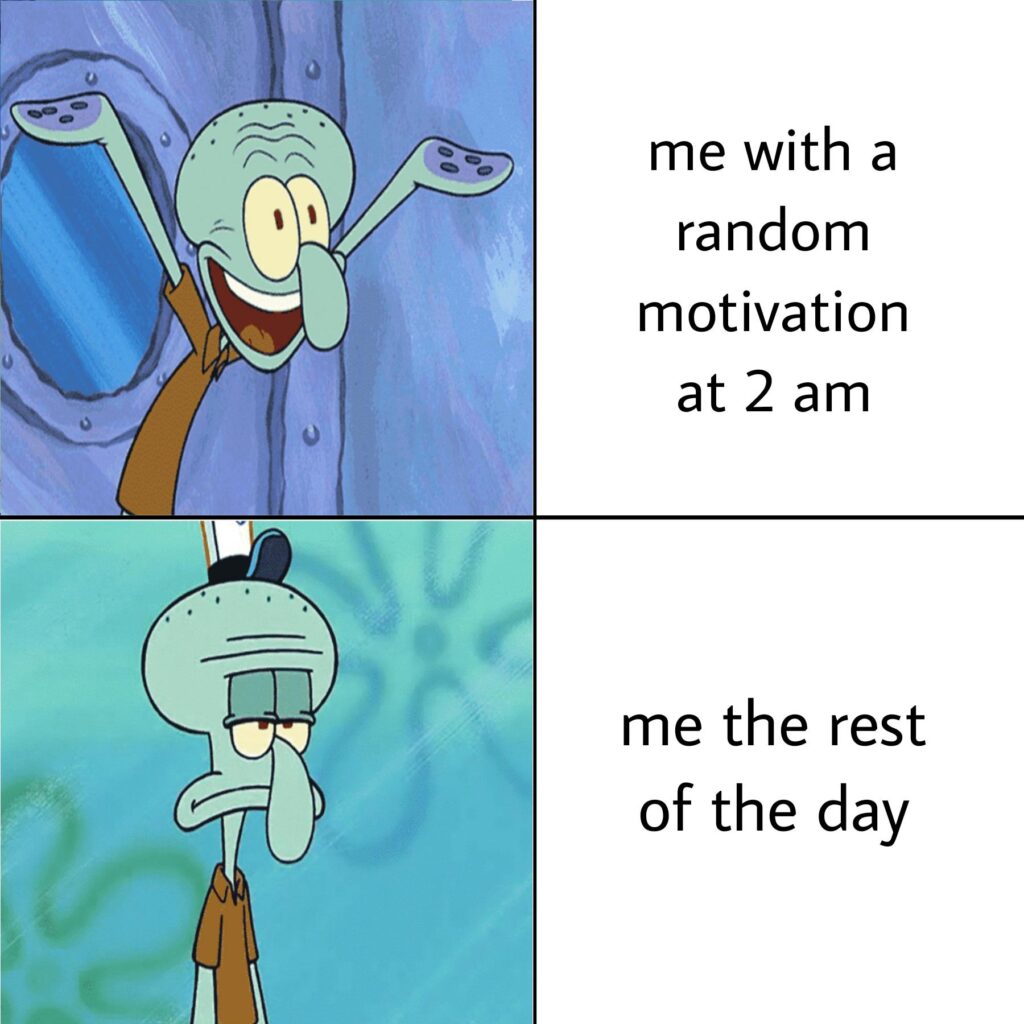
Motivation is important.
Unfortunately, how we view motivation – and seemingly ‘chase’ it – is flawed.
Aside from assuming that a lack of motivation means we’re ‘weak’ or ‘broken’, we attempt to summon its charm through hacks and tricks and reading ’10 Ways To Boost Motivation’ articles – all in the hope of, firstly, acquiring this spellbinding drive, and, secondly, attempting to hold onto it for longer than two weeks.
Harnessing the power of motivation, however, has little to do with ‘boosting’ it but more so cultivating the right kind of motivation in the first place.
Doing so will enable you to stay the course on your health and fitness journey for longer than two weeks, improve adherence, and encourage you to start working with a professional long before you’re ‘ready’ or ‘inspired’.
How can we acquire that right ‘type’ of motivation, then? Here’s how:
What Is Motivation?
Motivation is a condition inside us that desires a change, either in the self or our environment.
It’s the internal or external stimulus that prompts us to initiate, sustain, or direct our efforts toward achieving a particular goal or fulfilling a need or desire [1].
It’s why we’re ‘motivated’ to eat if we’re hungry. It’s why we’re ‘motivated’ to improve our deadlift technique if we’re getting stronger. It’s why we’re ‘motivated’ to exercise if we feel better for doing so.
When a combination of external forces (i.e., consequences, incentives, social pressures, etc.) and internal motives (i.e., needs, cognitions, emotions, etc.) align, they create an optimal environment for engagement and, therefore, action.
It’s why we’ll always seemingly have ‘more’ motivation at the beginning of the week or the start of a health and fitness endeavour. All conditions easily cooperate to forge a surge of motivation.
Unfortunately, those conditions don’t always last.
Subsequently, people assume they’re broken. That when they encounter a setback or don’t necessarily ‘feel’ like working towards any goals they have, they don’t ‘want it enough’.
That they’ve lost their motivation, and they, somehow, need to get it back – or, at the very least, find it in the first place.
Research has shown, however, that we’re always motivated to do something.
“At every moment we act in pursuit of what we most desire (want or need) at that moment” [2].
Appreciating that we’re always motivated to act in some way releases us from the confines of being ruled by needing more motivation.
It’s not so much that we need to coax out the motivational fairy deep inside us to help our cause but consider how to win the battle between being motivated to do two different things.
-> Wanting to exercise but also wanting to sit on the sofa
-> Wanting to eat the cake but also wanting to look after your health
-> Wanting to give in to food cravings but also wanting to look after your health
-> Wanting to hire a coach and make a change but also being comfortable with your current routine
Harnessing greater motivation for a task is ostensibly down to managing competing impulses and inhibitions, not necessarily finding or needing ‘more of it’.
As it’s been shown that behavioural interventions for weight loss typically focus on ‘increasing’ or ‘maintaining’ participants level of motivation – and have little regard for the quality – it’s time we ignore the need for this perceived ‘boost’ and focus on the types of motivation, instead [3].
It’s time to stop trying to unearth your misplaced motivation or only embark on a health and fitness programme with an online weight loss and nutrition coach when you’re eventually ready, but utilise this driving force in a completely different way.
Why You Don’t Need ‘More’ Motivation
It’s evident that motivation isn’t created equal.
It’s not that we ‘have it’ or ‘don’t have it’ but that our drives and desires exist on a continuum, depending on where that motivation is derived from.
While the plethora of models and processes of motivation go well beyond the scope of this article, we’ll be examining the different types of motivation pursuant to the Self-Concordance Model Of Goal Setting [4].
This refers to the alignment between an individual’s personal values, interests, and intrinsic motivations, and the goals they set for themselves.
In other words, a goal is considered self-concordant when chosen based on one’s own internal desires and aspirations rather than being influenced solely by external pressures or rewards.
There are four main types:
External/Extrinsic Motivation -> Goals are heavily guided by external circumstances. This type of motivation is regulated by compliance, external rewards, and outside pressures.
For example, ‘I have this goal because someone else told me to’.
Introjected Motivation -> Goals are characterised by self-image or ego-based motivation and are often pursued to avoid feelings of guilt, shame, or anxiety – or to gain a sense of self-worth or approval from others.
For example, ‘I have this goal because I feel guilty or anxious if I don’t’.
Identified Motivation -> Goals are perceived as personally important and meaningful, driven by personal values.
For example, ‘I have this goal because I value the character traits associated with it’.
Intrinsic Motivation -> Goals exist because of the enjoyment and stimulation the goal provides. The primary reason is simply the interest in the experience of goal pursuit itself.
For example, ‘I have this goal because I enjoy the process and challenges it provides me’.
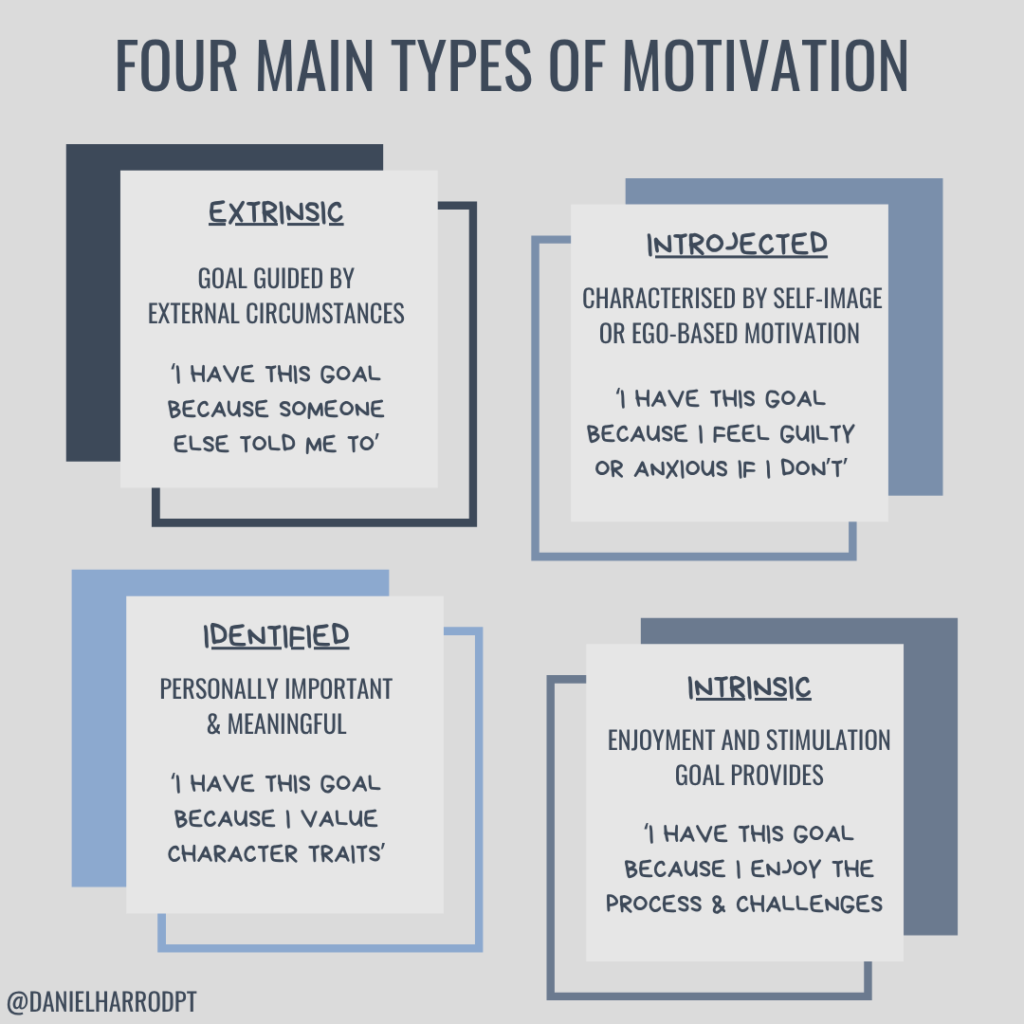
Essentially, self-concordant goals are more likely to lead to higher levels of motivation, persistence, and well-being.
It’s also no coincidence that research has shown the type of motivation we harness can influence health and fitness behaviours, specifically those who are more autonomous and intrinsically motivated, experiencing greater health outcomes [5].
When individuals are driven by intrinsic motivation arising from personal interest and enjoyment, they are more likely to sustain their commitment over time. This leads to increased effort, a higher level of engagement, and a sense of satisfaction derived from the activities themselves.
Of course, that’s not to say all extrinsic motivations are inherently ‘bad’. We can still execute a certain behaviour because it aligns with our personal values (e.g., ‘I want to lose body fat for my holiday, but I’m ensuring the methods I use to achieve this are aligned with living the ‘respectful’ and ‘committed’ life I want to lead), but, when it comes to long-lasting behaviour change, it’s clear that intrinsic motivation is often the winner.
One study, for example, showed that 135 people enrolled in a four-month weight loss programme focused on increasing intrinsic motivation and autonomy with their healthy eating and exercise behaviours [6].
While these individuals did lose weight, it was increased intrinsic motivation that was the best predictor of weight loss in the long term.
External motivation may be enough to propel people out of the starting blocks, but it’s often not enough to keep them going. This motivational quality is primarily based on the personal autonomy we experience.
It’s clear: some forms of motivation are stronger than others.
Which begs the question: do you lack motivation, or have you just not found the right type of motivation to consistently utilise yet?
Do you need to be motivated to embark on a health and fitness journey with a coach, or do you need to use a coach to help you cultivate a journey based on motivational reasons specific to you?
How To Cultivate The Right Type Of Motivation
If we’re always motivated, how can we ensure we’re cultivating the right type of motivation at the right times?
How can we ensure we’ll keep up with our attempts at behaviour change seventeen weeks into our journey, when challenges arise, the novelty has worn off, and progress has slowed?
Tame Your Intrinsic Motivation
Self-Determination Theory states there are three basic psychological needs essential for human growth, development, and well-being. Taming these will help improve your intrinsic motivation and ensure you’re continually motivated to implement the requisite tasks for the goals you have.
Fostering perceptions of:
-> Autonomy (i.e., whether we feel in control of our behaviours and goals)
-> Competence (i.e., whether we possess the skills required for success)
-> Relatedness (i.e., whether we feel as if we belong to a group or community of people)
Has been found to promote that optimal motivation [7].

This helps explain why those who enjoy exercise, who view it as a challenge, and who value the outcome of greater physical fitness, are more likely to display long-term exercise-adherence than those who engage in it, simply, for aesthetic reasons [8].
And it’s also why external forces – such as pressurising yourself to go to the gym because someone else said you need to lose weight, or participating in an eight-week weight loss challenge for a cash prize – will seldom lead to long-lasting change [9].
Whether it be finding a gym programme you enjoy following, tackling nutritional habits that are neither too challenging nor too easy, continually striving for mastery rather than perfection, or aligning your daily activities with your interests and personal growth, you’ll be able to improve your intrinsic motivation and, subsequently, always be able to work towards the goals you have.
Focus On Your Values & Why
Values are extensions of ourselves. They’re defined by what we elect to find meaningful in our lives. They’re the fundamental component of our psychological make-up and, ultimately, our identity.
Not only do values ensure we focus on particular character strengths over specific dieting methods – for example, displaying self-compassion and self-acceptance over banishing carbohydrates from our lives – but they promote greater internal motivation as well.
Ascertaining your values before anything else will provide you with direction. These are not necessarily defined by what you want to achieve but reflect your deepest desires for how you want to behave as a human.
Values will always matter, even if goals, emotions, and circumstances change.
It’s why you won’t need ‘more motivation’ when you align your behaviours with your values; it will simply always bubble away, driving you forwards.
Additionally, it’s also been shown there is a clear anatomical relationship in the brain between the segments involved in ‘valuation’ and those involved in the ‘self and identity’ [10].
If exercising consistently and always plating healthy, balanced meals becomes part of who we are, we won’t necessarily need motivation to act accordingly.
Take the time to consider what your values are and how you can fasten these to your internal motivations.
Develop Skills To Act During Tough Moments
Most people interpret tough moments as signs to stop what they’re doing, whereas, in fact, these are the moments that will determine whether lasting behaviour change transpires.
This act of committed action – the result of taking effective action in line with values and goals, in defiance of imperfect conditions – will ensure you’re always taking steps forward [11].
Committed action is about staying the course, even when difficult moments emerge – including when you can’t see or feel the progress you’re making.
-> It can mean feeling tired and still going for a long walk.
-> It includes experiencing thoughts that you’ll never shift the weight but still making home-made lunches for the week.
-> It can mean wanting the snack but sitting with that emotional discomfort instead.
-> Committed action is having to look after two kids, work long hours, and deal with a leak in your bathroom, but still going to bed on time to achieve a regular sleep schedule.
Such action outlines the characteristics you’ll live your life by and creates strategies to boost commitment to your values and goals. You’ll break through that mental pain barrier to achieve what you want.
Building the psychological flexibility to carry tough experiences around with you helps bolster the right type of motivation at the right times.
This willingness to experience discomfort proves that you aren’t influenced by how you feel in the moment.
Ask yourself:
“Am I prepared to experience this discomfort if it means moving towards the life I want?”
When you can cultivate the right type of motivation that’s strong enough to support committed action, even when your thoughts, emotions and cravings are pulling you elsewhere, you’ll be better set to succeed in the long run.
Stop Focusing Solely On Your Appearance
It’s no secret that the majority of people undertake health and fitness journeys with the intention of changing their appearance.
While this is a valid goal – when utilised correctly – there has been research to show that ‘proximal and extrinsic motivations’ aren’t likely to promote long-term engagement and weight loss maintenance.
These types of goals are typically more controlled than autonomous, thereby making them lower quality.
Not only that, but individuals motivated to lose weight solely based on appearance reasons versus ‘health reasons’ were found to be more likely to use unhealthy eating strategies [11].
One study, for example, showed that women highly motivated for weight loss due to self-appearance reasons were the least successful in an intervention, compared with those who attempted to change through health reasons [12].
If you’re only exercising and eating well to get that six-pack or grow those glutes, you may well run into problems later down the line.
While you can still incorporate appearance motives into your goal setting process, it’s important to ensure the majority of your desires are intrinsically driven. Consider:
-> What behaviours would you engage in even if your physique didn’t change?
-> How would these changes support other areas of your life?
-> What are the additional benefits of focusing on nutrition and exercise behaviour changes?
Seek Professional And Empathetic Help
Health and fitness coaches, mindset mentors, and personal trainers tend to be underrated.
While images of megaphones and cries of, ‘Ten more burpees’ seem to be the norm, hiring a militant commander or taskmaster is often far from the truth.
Personal trainers and online coaches are there to keep health and fitness journeys on track, to help figure out the right goals, the right process, and the right types of motivation in place for you to achieve the goals you have.
The act of keeping accountable to a trainer or coach – and following their professional guidance – goes well beyond ensuring they’re present to just give you ‘two more reps’.
Effective coaches understand what people are going through, and will put systems, tactics, and plans in place, to ensure their clients are always striving towards whatever goals they have – because they’ve helped them develop the right types of motivation behind starting a new journey.
Acquiring that branch of accountability and expert support will do more for your fitness success than any superfood fad, or ‘fat-burning programme’ will.
If you’re still finding yourself wanting ‘more’ motivation or similarly struggling to stay adherent to any goals you set yourself two weeks into your journey, you can contact us today so we can discuss how best to cultivate the right type of motivation, goals, and processes to help you achieve the ambitions you have.
You don’t need ‘more’ motivation; you need the right ‘type’ of motivation.
The Quick-Fire Motivation Q&A
What is the best type of motivation for long-term weight loss?
Harnessing greater motivation for a task is ostensibly down to managing competing impulses and inhibitions, notnecessarily finding or needing ‘more of it’.
Intrinsic motivation is generally considered the strongest predictor of long-term behaviour change. When your eating and exercise habits are driven by your personal values, interests and enjoyment of the process, you’re far more likely to stay consistent than if you’re motivated solely by external rewards or appearance.
Why do I lose motivation to exercise after a few weeks?
It’s not so much that we need to coax out the motivational fairy deep inside us to help our cause but consider how to win the battle between being motivated to do two different things. As the novelty of a new exercise programme wears off and life becomes more challenging, competing motivations begin to emerge.
Rather than trying to ‘boost’ your motivation, it’s more effective to cultivate intrinsic motivation and continue taking committed action that aligns with your values.
How can I stay motivated when I don’t feel like exercising?
You don’t need to ‘feel’ motivated every day to remain consistent and take steps towards your long-term ambitions.
Committed action – the result of taking effective action in line with values and goals, in defiance of imperfect conditions – will ensure you’re always moving in the right direction. Building on the willingness to experience discomfort will help you when you’re not feeling your best.
How do I stop relying on motivation to eat healthy?
Rather than waiting until you feel inspired, focus on creating healthy habits that require less motivation to perform. Align your eating behaviours with your personal values, reduce unnecessary friction, and work towards that goals that aren’t exclusively appearance-based.
Motivational quality is primarily based on the personal autonomy we experience.
References
1. Reeve, J. (2015). Understanding motivation and emotion (6th ed.). Hoboken, NJ: Wiley.
2. Michie S, West R, Campbell R, Brown J, Gainforth H. (2014), ABC of behaviour change theories: an essential resource for researchers, policy makers and practitioners. London: Silverback Publishing.
3. Teixeira, P. J., Silva, M. N., Mata, J., Palmeira, A. L., & Markland, D. (2012). Motivation, self-determination, and long-term weight control. The International Journal of Behavioral Nutrition and Physical Activity, 9, Article 22
4. Sheldon, K. M., & Elliot, A. J. (1999). Goal striving, need satisfaction, and longitudinal well-being: the self-concordance model. Journal of Personality and Social Psychology, 76(3), 482
5. Ng, J. Y. Y., Ntoumanis, N., Thøgersen-Ntoumani, C., Deci, E. L., Ryan, R. M., Duda, J. L., & Williams, G. C. (2012). Self-determination theory applied to health contexts: A meta-analysis. Perspectives on Psychological Science, 7(4), 325–340.
6. Teixera, P.J., Going, S.B., Houtkooper, L.B., Cusser, E.C., Metcalfe, L.L., Blew, R.M., Sardinha, L.B., & Lohman, T.G. (2006). Exercise motivation, eating, and body image variables as predictors of weight control, Medicine and Science in Sports and Exercise, 38(1), 179-88.
7. Deci, E. L., & Ryan, R. M. (2000). The “what” and “why” of goal pursuits: Human needs and the self-determination of behavior. Psychological Inquiry, 11(4), 227–268.
8. Gjestvang, C., Abrahamsen, F., Strensrud, T., & Haakstad, L.A.H. (2020). Motives and barriers to initiation and sustained exercise adherence in a fitness club setting – A one year follow-up study. Scandinavian Journal of Medicine & Science in Sports, 30(9), 1796-1805
9. Williams, G. C., Grow, V. M., Freedman, Z. R., Ryan, R. M., & Deci, E. L. (1996). Motivational predictors of weight loss and weight-loss maintenance. Journal of Personality and Social Psychology, 70(1), 115–126
10. De Ridder, D. (Ed.), Adriaanse, M. (Ed.), Fujita, K. (Ed.). (2018). Routledge International Handbook of Self-Control in Health and Well-Being. London: Routledge.
11. Gardner, F. L., & Moore, Z. E. (2007). The psychology of enhancing human performance: The Mindfulness-Acceptance-Commitment (MAC) approach. Springer Publishing Co.
12. Putterman, E. & Linden, W. (2004), Appearance Versus Health: Does the Reason for Dieting Affect Dieting Behavior? Journal of Behavioral Medicine, 27(2), 185-204.
13. Mroz, J.E., Pullen, C.H., & Hageman, P. A. (2018). Health and appearance reasons for weight loss as predictors of long-term weight change. Health Psychology Open, 1-8.
Need some help? Download my free How To Win At Fat Loss Guide!

By submitting your email you agree to receive my regular funny, witty, and enlightening emails and marketing offers via email.