

It sits there, taunting you.
It should be eaten.
It’s a waste otherwise, right?
What about the starving children on the other side of the world?
What about the fact that you paid for it?
And so, without being asked twice, you do eat it.
Except, should you have done?
Should you have eaten that last bite? The last spoonful that lay in your bowl? That small piece of your children’s dinner that they couldn’t quite finish?
The fear of wasting food compels you to overeat.
Which only exacerbates further feelings of guilt and shame around your eating habits and body.
You don’t know what to do, subsequently conjure up weak justifications for your actions, and seldom align your behaviours with your health-based ambitions.
So, what can we do?
How can we overcome this fear of wasting food?
Why Do You Fear Wasting Food?
1. You’re Afraid of Feeling Guilty or Judged Regarding Food Waste
You finish every last crumb on your plate, hoover up those last few bites, or say ‘yes’ to dessert because you’re worried about what others will think of you.
You fear being judged and so ignore how you truly feel to fit in and avoid shining a light on your actions.
Which, of course, leads to needless overeating.
Not to mention the guilt or anxiety around leaving food on your plate, potentially elevating stress levels, which, in turn, may trigger overeating as a coping mechanism – even if you’re not truly hungry.
The next time you’re tempted to finish that last mouthful, even if you know you’re not hungry, just consider whether you’re being dictated by your perception of others around you.
It’s important to always set your own boundaries and prioritise your own well-being, even if that means leaving food behind – and being judged by others.
2. Childhood Experiences Are Dictating Your Current Beliefs
‘Go on, just have the last bite.’
‘If you finish your dinner, you can have dessert.’
‘Have two chips for every mouthful of chicken.’
I’m sure you heard at least some iteration of these statements when you were younger.
It’s no coincidence then that you’ve grown up with the belief that everything must be finished on your plate for fear of facing punishment or even potentially missing out on a reward, whether praise or the delights of a chocolatey dessert.
These controlled feeding practices (i.e., ‘you will eat this’) are often the underlying mechanism behind our beliefs around food and the fear of wasting anything.
If we’ve also been conditioned to believe clearing food is a prerequisite for other activities (i.e., playing or being allowed a dessert), then we start to look at consuming food as an ‘achievement’ or barometer of success, leading us to override fullness cues and subsequent health problems.
If we only receive certain things when we finish our plates, then, as kids, we’re going to damn make sure we finish our plates – even if means feeling like your stomach is about to explode.
Additionally, if you grew up with anxieties around food availability, whether due to financial constraints or a family culture emphasising every bite’s value, this could further exacerbate your concerns around wasting food as you get older.
Just think back to your childhood experiences: do these influence how you view food, not necessarily what you now think about food?
3. You Identify Wasting Food With Wasting Money
It can often feel as if you’re throwing money down the drain should you leave food on your plate – especially if you’re out at a restaurant.
‘I paid for it, so I’m going to bloody well eat it.’
Even if we take leftovers home, it can still trigger the fear of wasting the flavour of the meal or even the experience.
It’s important to remember, however, that you’re not charged dependent on how much of your meal you eat; you’re charged the same amount regardless of whether you finish your meal or not.
If you’re worried about wasting money at home, maybe it’s time to look at your portion sizes, or even how much food you purchase in the first place.
Getting clear on how much we value feeling ‘normal’ around food can help us devalue the money ‘wasted’ on a meal half-eaten.
4. You Have FOMO
Throwing away food can evoke a fear of missing out on the sensory and social experience of a meal.
If you stop eating while others continue to enjoy their meal, it can heighten this sense of missing out.
This fear extends to leftovers as well, as they often don’t taste as good the next day, intensifying the fear of foregoing a flavourful experience and devouring everything there and then.
Similarly, you’re apprehensive about ‘never having that food again’ which, often, just isn’t the case.
Of course, there’s a time and a place for embracing the cuisine or experience, but, often, we can forego an item in line with our body’s signals because we’ll probably have it again at some other point.
If you’re neglecting hunger and fullness cues at the expense of fitting in or conforming to societal norms, you’re missing the point of what eating is really about.
5. You’re Fearful Of World Hunger
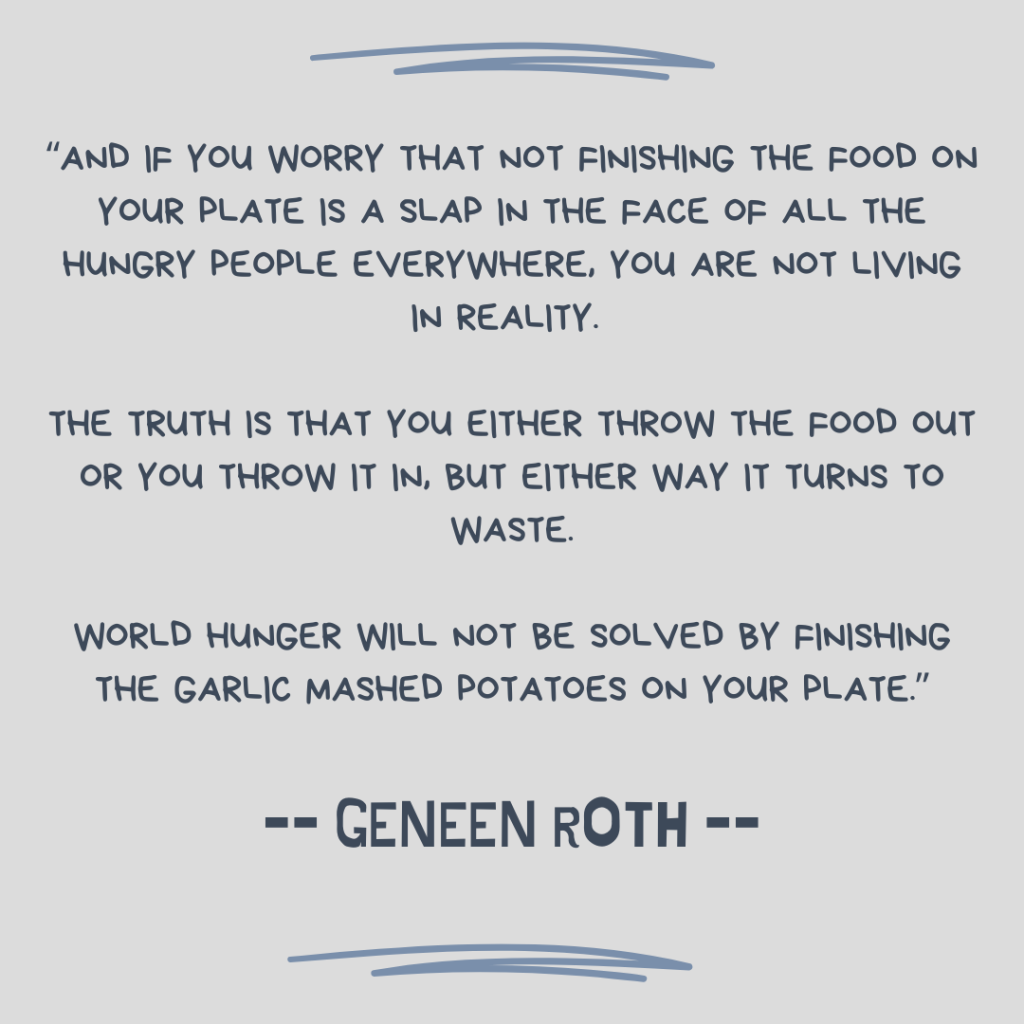
Cleaning your plate to avoid waste might seem beneficial, but it actually does very little to address global hunger or reduce environmental issues.
Eating in excess under the guise of avoiding waste and ‘minimising poverty’ contributes neither to solving world hunger nor to reducing environmental impact.
Largely because world hunger is often caused by factors out of our control, like poverty, inaccessibility to food, political instability, and natural disasters, which cannot be solved by just ‘eating less wastefully’.
Instead, we should prioritise mindful consumption and intentional giving, which, instead, fosters long-term self-sufficiency and sustainability.
Honouring cultural traditions and caring for the planet doesn’t require overeating — it, ultimately, means making thoughtful choices that support both personal health and global well-being.
Questions To Ask Yourself About Your Fear Of Wasting Food
-> What Does ‘Wasting Food’ Mean?
Do you or others actually benefit in any way from scoffing down those last few mouthfuls? Or are you then left feeling bloated, stuffed, and uncomfortable? Who is that actually helping?
Is that in any way helping the potential wastage of those particular food items?
What actually causes food wastage? Is taking more of a concern around policies that advocate food access, reducing waste, and supporting organisations that work to redistribute food surpluses more beneficial?
-> Is ‘Investing’ In Your Health (i.e., Not ‘Eating Because You’ve Paid For The Food’) More Of A Long-Term Strategy To Avoid Food Waste?
If you’re generally ‘healthier’, then you’re a) less likely to pay for other health-related ‘fixes’ (i.e., that detox diet you tried last month) and b) less likely to be a burden on the health system in the future.
This may seem far-fetched, but is this any different to telling yourself you must eat the last few mouthfuls because others in the world can’t eat? Are those others actually benefiting?
Is looking after yourself now more beneficial for world food issues in the future?
-> What If A Restaurant Had Served You 20% Less Food Than They Did Without You Knowing?
You probably would have eaten this without giving it a second thought. Are you in control of what they give you? No. So, why are you succumbing to their pre-set serving sizes?
Should you be eating the same amount of food as your partner, who should be eating the same amount as a friend, who should be eating the same serving size as the couple sitting next to you at the restaurant? Why do you then all end up consuming the same amount?
You’re not in control of what others think you should be having (i.e., restaurants, friends, etc.), but you are always in control of when you stop eating.
-> What Memories Can You Bring Up From Your Childhood?
What were you taught when you were younger about food? How did your parents or grandparents react to food waste? Were you forced to finish everything on your plate before being allowed dessert? Were you ‘rewarded’ for eating more?
How has this served you in your life? Were they ‘right’ in their views? What if they were wrong?
What if you had the chance to change the narrative right now?
How To Manage Your Fear Of Wasting Food
1. Experiment With Different Portion Sizes
The amount of food you think you need often differs greatly from what you actually need.
How many times have you served up a plate or bowl of food, then added a little bit extra because it didn’t ‘look’ like enough, only to realise you were full about halfway through the meal but felt as if you had to keep eating?
Start experimenting with different portion sizes and putting less food on your plate to begin with. If you realise you’re still hungry after finishing, then great, you can go back for more.
Often, however, you’ll realise that you probably put enough on your plate the first time around and are feeling content with the amount you’ve had and how you feel.
It’s cliché, but often our ‘eyes are bigger than our stomach’. You don’t need as much food as you think you do to function well and be content with your bodily sensations.
If you serve a smaller portion size and there’s food left in the pan or dish, then you can simply use this for a meal later on in the day or week. Or even donate this to someone in need.
2. Create A Weekly ‘Clean Out Meal’
There’s often a significant build-up of food in our fridges and cupboards come the end of the week or month.
Instead of scoffing down food needlessly with each meal so it ‘doesn’t go to waste’, think about creating a meal that uses all these ingredients and puts it to better use.
This is a far more effective way of managing food waste than eating mindlessly to ‘use it up’.
Take stock of what food doesn’t get eaten in your household and look to purchase smaller containers/packaging. Can you look for alternatives? Can you find different recipes? Can you make smaller portion sizes?
3. Set A Good Example For Your Children And/Or Others
Many parents will often want to set a good example to their children and not ‘waste food’.
While the pointers above will hopefully negate these fears, it’s worth asking yourself what a true good example actually looks like.
Imagine your children in 20 years’ time: what kind of healthy lifestyle would you like them to lead?
Would this mean them devouring everything in sight and potentially struggling with weight and health, or being in complete control of their hunger and fullness cues and knowing when enough is enough?
What’s more important to you: eating all that food right now or looking after your kids’ health in years to come? How do you want them to act when they’re your age?
Often, setting a ‘good example’ is about respecting your body, not engaging in mindless and profligate eating.
4. Donate
If you’re worried about wasting food because of the situation in third-world countries, then remind yourself that eating extra food doesn’t actually help them.
The food on your plate is already in your possession.
Whether you eat it or throw it away doesn’t change the fact that others in need didn’t have access to it in the first place. The real issue is global food distribution and accessibility, not just waste.
And, of course, while personal food waste still matters under the right context, the majority of food waste occurs in production, storage, and distribution — before it even reaches consumers.
Supermarkets, restaurants, and farms discard massive amounts of edible food due to overproduction, appearance standards, and logistical failures. These are often the issues that need tackling.
Instead, make a donation to a charity that feeds hungry adults and kids. Because a donation would actually help them.
World hunger is driven by poverty, conflict, climate change, food waste at industrial levels, and inefficient supply chains.
Individual eating habits don’t directly impact these structural issues.
5. Do The Maths
If you can look down at your plate, realise you’re full but are worried about the food that’s leftover, just consider what’s worth more to you.
Let’s say you have 20p worth of rice and 50p worth of chicken left on your plate.
Is your relationship with food worth more than 70p?
People will spend hundreds of pounds on diet protocols, supplements, cleanses, and quick-fix products, but are worried about losing 70p worth of food.
Your relationship with food and body is, and always will be, worth more than that.
6. Practice Leaving One Bite Of Food On Your Plate
We’re often at the mercy of what we have on our plate – either served by us or others – not what we actually need in that moment.
The more we can recognise this, the easier it is to actually eat for what we need.
Practicing leaving one bite of food on your plate will break that ‘clean plate’ habit, along with encouraging you to listen to your body’s signals and eat in a way that’s good for you, physically and mentally.
It will also teach you more about appropriate portion sizes and the amount of food you actually need.
The beauty of leaving just one bite is that it’s not a huge stumbling block to overcome at first. You’ll reduce the amount you fear ‘wasting’ and slowly build up confidence that, ultimately, it’s OK to do so.
Of course, leaving a bite of food on your plate shouldn’t come from a place of restriction, but if you’re the type of person who struggles with always feeling stuffed after finishing a meal, then leaving one bite behind will help you develop the skill to stop eating when full — or at least work your way towards that goal.
7. Give Yourself Permission To Let Go
Liberating yourself from the fear around food wastage doesn’t mean being careless — it means being kind to yourself while learning how to minimise waste over time.
It’s time to acknowledge that some food just can’t be saved and that throwing it out is sometimes the best option.
This reduces the chances of negative health consequences, from the emotional burden of shoehorning food into your day to the health risks from sometimes eating questionable food items.
Instead of thinking, ‘I wasted this food, I’m a bad person,’ shift to ‘How can I prevent this in the future?’
Food waste isn’t a personal failure. It’s a common challenge that can be improved with awareness and small habit changes.
The key is to shift from guilt to growth so that managing food waste feels empowering, not stressful.
The Very Important End Of Article ‘FAQ’
1. Why Do I Feel Guilty Leaving Food On My Plate?
Guilt around food waste often stems from external pressure, whether it’s the fear of being judged, childhood conditioning, or cultural narratives. Many of us were raised to associate finishing a plate with being “good” or responsible. But guilt isn’t a reliable guide for what your body needs. Eating beyond fullness to avoid waste doesn’t solve the issue; it just transfers the cost to your health and well-being.
2. Isn’t Wasting Food The Same As Wasting Money?
It might feel like throwing away money when you don’t finish a meal, but the money is already spent. Eating past your needs doesn’t get the value back – it just compromises how you feel. A better long-term financial strategy is learning how to portion better, shop more intentionally, and reduce waste before it happens. Your health and relationship with food are worth more than the cost of a few uneaten bites.
3. What If I Was Taught To Always Clean My Plate As A Child?
Many of us were raised with well-meaning but misguided messages around food. These early experiences often shape how we feel about waste and fullness, even decades later. The good news is: those beliefs can be unlearned. You can honour your past while choosing new, healthier behaviours that support your current values and well-being.
4. Isn’t It Selfish To Throw Food Away When Others In The World Are Starving?
It’s a common belief, but overeating doesn’t reduce world hunger. Global food insecurity is rooted in systemic issues like poverty, conflict, and inequality, not what’s left on your plate. A more impactful approach is to donate to food redistribution organisations and become more intentional with your food choices. Mindful consumption is far more powerful than self-sacrifice.
5. How Can I Reduce Food Waste Without Overeating?
Start small: experiment with smaller portions, repurpose leftovers creatively, and create weekly “clean-out” meals. Leaving just one bite behind can also be a helpful way to break the clean plate habit. Most importantly, give yourself permission to stop eating when you’re full, even if there’s food left – it’s a practice of self-respect, not wastefulness.
Need some help? Download my free How To Win At Fat Loss Guide!

By submitting your email you agree to receive my regular funny, witty, and enlightening emails and marketing offers via email.
How To Win At Fat Loss

Download my FREE eBook on How To Win At Fat Loss and you’ll learn…
- Why everyone usually fails when it comes to trying to shed body fat
- Why you should be lifting weights
- Why calories are so important
- Why weighing yourself is a no-no
- Why mastering nutritional habits are the key to success
All so you can…
- Finally stop failing and start winning at fat loss
- Finally shed inches, drop dress sizes, and actually see a change for once
- Finally transform your body and mind so you’re not constantly battling those dieting demons
- Finally figure out how to lose the fat, keep it off, and flaunt the figure you’ve always dreamt of displaying